Fertility, Microplastics
The Invisible Threat: What Microplastics Are Doing to Your Fertility
BEFORE YOU READ :
- In 2025, microplastics were found for the first time inside the follicular fluid of women undergoing IVF — the fluid that surrounds and nourishes your developing eggs.
- Microplastics disrupt fertility primarily by acting as endocrine disruptors, increasing oxidative stress in ovarian tissue, and interfering with hormonal signalling.
- You cannot eliminate exposure entirely. But you can reduce it meaningfully with practical, consistent choices.
- Dietary fibre and antioxidants support your body's ability to move microplastics through and limit the inflammatory damage they cause.
- This is an evolving field. The research is real and concerning, but causal links in humans are still being established. Panic is not the appropriate response — informed action is.
In my practice, when patients ask me about things that could be affecting their fertility that are not obviously medical, I almost always end up talking about two things: what they eat and what they are exposed to. Microplastics sit squarely in the second category. And in the last few years, the research has moved from animal models to human tissue — which is what makes this conversation more urgent.
Let me start with a finding that I think every woman in her reproductive years should know about.
In 2025, a team of Italian researchers published the first study to find microplastics directly inside human ovarian follicular fluid — the fluid that surrounds the eggs inside the follicles where they develop. [1] They were examining 18 women undergoing IVF. Microplastics were detected in 14 of the 18 samples. They also observed a correlation between higher microplastic concentrations and elevated FSH levels — a marker associated with ovarian stress.
This study does not prove that microplastics cause infertility in humans. But it does confirm something we should have suspected: these particles are reaching the ovarian environment. They are not staying in the gut. They are crossing biological barriers and arriving at precisely the place where your eggs are forming.
🔬What exactly are microplastics — and how do they get in?
Microplastics are fragments of plastic smaller than 5 millimetres — and often much, much smaller. They form when larger plastic objects break down in the environment from heat, sunlight, and mechanical wear. They also come in primary forms: manufactured small, as the microbeads once found in face scrubs and toothpastes, or the tiny pellets used in industrial plastic production.
The reason they are everywhere is because plastic does not biodegrade. It just fragments into smaller and smaller pieces, eventually reaching nanoscale sizes that can cross cell membranes. [2] Once absorbed into the human body, studies have detected them in the liver, spleen, lungs, kidneys, blood — and now, ovarian follicular fluid.
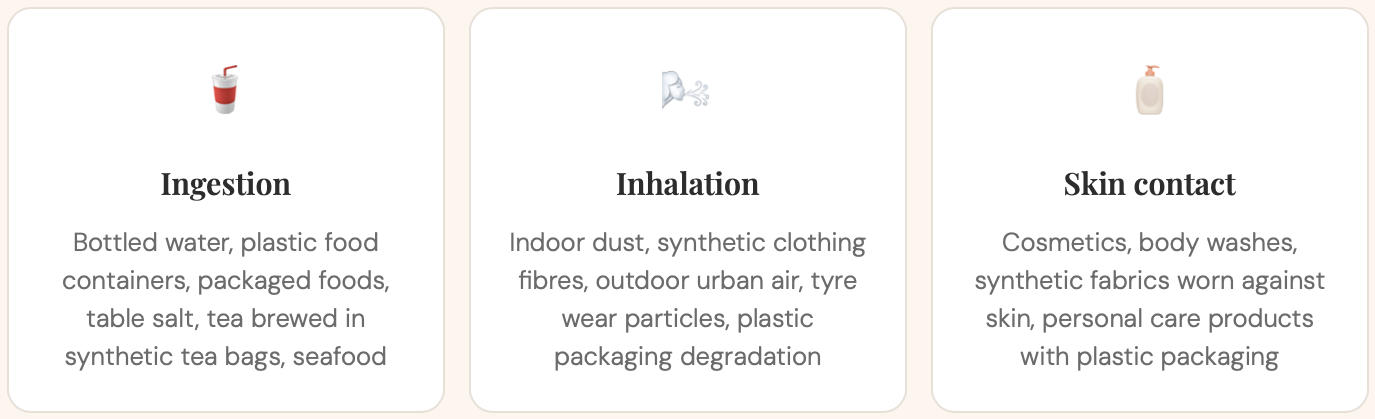
There are three main ways they enter your body:
A NOTE SPECIFIC TO INDIA :
A 2025 study found that microplastics now constitute up to 5% of particulate matter in the air of Indian cities including Mumbai, Delhi, Kolkata, and Chennai. [3] The major exposure pathways flagged for urban Indians are packaged food, packaged milk and water, cosmetics, and inhalation — all of which are daily habits for most of us.
A lesser-known source worth mentioning: research has specifically examined plastic leaching from paper cups and tea bags used in India, finding that plastic coatings on paper cups degrade in hot water, releasing compounds including phthalates into the beverage. [4] For a country where chai is a daily ritual, this is a detail that matters.
⚗️How do microplastics interfere with fertility?
The mechanisms are becoming clearer, even if we are still building the full picture in human studies. There are three main pathways through which microplastics appear to affect female reproductive health.
1. Endocrine disruption — the hormone interference problem
Microplastics are not just plastic. They act as carriers for other toxic chemicals — including BPA, phthalates, and heavy metals — that bind to their surfaces. [5] These chemicals are known endocrine disruptors: they mimic or block the body's natural hormones, particularly oestrogen.
When synthetic oestrogen-like compounds enter the body, they can disrupt ovulation, affect endometrial receptivity (the uterus's ability to accept an embryo), and interfere with the delicate hormonal sequence that governs the menstrual cycle. The concern is that this is happening continuously, at low levels, across years of exposure — not as a one-time event.
2. Oxidative stress — the egg quality problem
Animal studies have consistently shown that microplastic exposure increases oxidative stress in ovarian tissue — the same mechanism we discussed in the context of egg quality in our previous article. [6] Oxidative stress damages mitochondria, and mitochondrial health is central to how well an egg can mature, be fertilised, and develop into a viable embryo. A 2025 systematic review across 15 studies confirmed that microplastic exposure significantly affects ovarian function and disrupts hormone levels in female subjects.
3. Follicular disruption — the ovarian reserve problem
Research on mice has shown impaired follicle development following microplastic exposure — fewer healthy follicles developing, and disruptions to the balance of oestrogen and progesterone. [7] The Italian follicular fluid study mentioned at the start of this article also noted the correlation between microplastic concentration and elevated FSH — which can be a signal that the ovaries are working harder than they should.
"Microplastics are not just a pollution problem. When they reach the fluid surrounding your developing eggs, they become a reproductive health concern — one that we are only beginning to fully understand."
🛡️What you can actually do — practically and without panic
I want to be measured about this section. Reducing microplastic exposure requires consistent, structural changes to how you live — not a one-week detox or a single product swap. No single change will eliminate the problem. But a series of deliberate shifts will meaningfully reduce your body burden over time.
Think of this the way you think about sun protection: you cannot avoid the sun, but you can wear SPF, avoid peak hours, and cover up — and that combination makes a real difference even if it is not a perfect shield.
💧 Filter your drinking water
Bottled water is not safer — a 2018 study found microplastics in 93% of bottles tested across 11 brands. [8] Even twisting the cap of a single plastic bottle can release up to 500 microplastic particles. A reverse osmosis filter or a good activated carbon filter at home is the more protective option. If you are in a city where tap water is safe to filter and drink, this is one of the highest-impact changes you can make.
🫙 Move food and heat away from plastic
Never heat food in plastic containers — not even ones labelled microwave-safe. Heat accelerates the release of plastic particles and chemical additives into food. Store leftovers in glass, steel, or ceramic. For dabbas and tiffins especially, this switch is worth making permanently. [9]
🫖 Rethink your chai cup
If you are drinking chai or coffee regularly in paper cups — at the office, from street stalls, at events — this is a meaningful source of exposure. Paper cups are lined with plastic that degrades in hot liquid. Carry your own steel or ceramic cup where you can, or use traditional kulhad-style clay cups which are becoming more available. At home, brew tea loose in a steel or clay vessel rather than synthetic tea bags. [4]
🌿 Eat for fibre — and mean it
Dietary fibre plays a specific protective role here. Research published in Food Frontiers (2024) found that insoluble dietary fibre can bind microplastic particles in the gut and facilitate their excretion — reducing the time they spend in contact with the gut lining and the amount that may cross into the bloodstream. [10] Aim for 25–35 grams of fibre daily. Dal, sabzi, whole grains, flaxseeds, chia, and seasonal fruit — eaten consistently — cover most of this for an Indian diet.
🫐 Prioritise antioxidants in your diet
Antioxidants directly combat the oxidative stress that microplastics generate in the body. [11] Colourful fruits and vegetables, green tea (in a ceramic cup), turmeric, berries, dark leafy greens, and walnuts all contribute. This is not a detox — it is ongoing cellular protection. The same foods that support egg quality in general are also the foods that support your body's resilience against microplastic-related damage.
👗 Choose natural fibres where possible
Synthetic fabrics — polyester, nylon, acrylic — shed microplastic fibres when worn and especially when washed. These end up in indoor air and water. Switching to cotton, linen, wool, and silk for clothing worn close to the body is a meaningful reduction over time. [12] Washing synthetic clothes less frequently and at lower temperatures also reduces shedding.
🧴 Be intentional about personal care products
Many cosmetics, face washes, and body scrubs still contain plastic microbeads or come in packaging that sheds particles on the inside. Check for polyethylene, polypropylene, or nylon in ingredient lists. The EWG's Skin Deep database is a useful reference for checking what is in your everyday products. Fragrance-heavy products are also frequently high in phthalates — the same endocrine-disrupting chemicals that hitch a ride on microplastic particles inside the body.
WHAT ABOUT AIR QUALITY INDOORS?
A meaningful amount of microplastic exposure comes from indoor air and dust — from synthetic furnishings, carpets, and clothing fibres that settle and become airborne. In Indian cities where outdoor air quality is already compromised, this matters. Simple steps: vacuum regularly with a HEPA-filtered machine, use cotton or linen fabrics for bedding and curtains where possible, and ventilate rooms that tend to collect dust. None of this is dramatic. Collectively, it reduces the particle load in the air you breathe every day.
💊 Does your supplement protocol help here?
The supplements discussed in our previous article — CoQ10, Vitamin E, omega-3 fatty acids — are relevant here as well, though through a slightly different lens. Their role is not to remove microplastics from the body. It is to mitigate the specific kind of damage that microplastics cause: oxidative stress, mitochondrial dysfunction, and chronic low-grade inflammation.
CoQ10's antioxidant role in protecting mitochondria in oocytes is directly relevant when we consider that microplastics increase mitochondrial oxidative stress in ovarian tissue. [13] Omega-3 fatty acids reduce systemic inflammation. Vitamin E protects cell membranes from oxidative damage. These are not microplastic-specific interventions — they are general defences against the specific biological damage that microplastics cause.
WHAT SUPPLEMENTS CANNOT DO :
No supplement removes microplastic particles from your body. There are products marketed as "microplastic detoxes" — chlorella, activated charcoal, modified citrus pectin — and while some of these may have some binding capacity in the gut, the evidence for most of them is preliminary at best. Be sceptical of anything marketed as a complete solution to microplastic exposure. The most powerful tools remain reduced exposure and a body that is nutritionally supported to handle the inflammation.
🧭 How to think about all of this without catastrophising
I am aware that articles about environmental toxins and fertility can read like a list of reasons to feel helpless. That is not the intention here, and it is not a useful place to land.
The honest picture is this: microplastics are in the environment at a scale that no individual can reverse alone. They are in your body right now — as they are in mine. The research confirming their presence in ovarian tissue is new and significant, but causation in humans is still being studied. We do not yet have large-scale data confirming that microplastic exposure causes infertility in otherwise healthy women.
What we do have is enough mechanistic evidence — and enough preclinical and emerging human data — to justify taking reasonable, practical steps to reduce exposure. Not because doing so assures one better fertility outcomes. But because, cumulatively, these choices reduce the oxidative and hormonal burden on your reproductive system at a time when you may well want it functioning at its best.
The practitioner's honest view.
When a patient asks me whether microplastics are affecting her fertility, I do not say "we don't have enough evidence yet, so don't worry about it." I also do not say "yes, this is probably why you're struggling." Both of those answers would be dishonest.
What I say is: we know enough to act cautiously, and acting cautiously here costs very little. Switching your water container to steel, cooking in stainless or cast iron, eating more dal and less packaged food, swapping your synthetic tea bags for loose leaf — none of these changes require wealth or extreme effort. They are the kind of ordinary, consistent habits that compound over months and years.
They will not reverse age-related fertility decline. They will not fix a structural issue or a genetic one. But they are part of creating the most supportive biological environment possible — which is ultimately all that lifestyle medicine can offer. And for most of us, that is more than nothing.
The science on microplastics and human fertility will continue to evolve. I will update this article as significant new research emerges. If there is one takeaway I would leave you with: this is not a problem to panic about, but it is also not a problem to dismiss. It sits squarely in the category of things we can respond to thoughtfully — which is where most useful medicine lives.
RESEARCH REFERENCES
Montano et al. First evidence of microplastics in human ovarian follicular fluid. Ecotoxicology and Environmental Safety, 2025. medRxiv ↗
Ferrante et al. Microplastics: A Real Global Threat for Environment and Food Safety. PMC, 2023. PMC ↗
Biswas et al. Microplastics in urban particulate matter in Indian cities. Down to Earth, 2025. Down to Earth ↗
Gujral et al. Microplastics in paper cups and tea bags: concern in India. Discover Applied Sciences, 2025. Springer ↗
Montano et al. First evidence of microplastics in ovarian follicular fluid — full preprint. medRxiv, 2024. medRxiv PDF ↗
Inam Ö. Impact of microplastics on female reproductive health: systematic review. Archives of Gynecology and Obstetrics, 2025. Springer ↗
The Lucky Egg. Microplastics and Fertility: Is It Time to Panic? 2025. The Lucky Egg ↗
EWG. Top 5 Ways to Reduce Your Microplastic Exposure, 2024. EWG ↗
Beyond Plastics. Reduce Your Exposure to Microplastics. Beyond Plastics ↗
Wang et al. Fighting microplastics: The role of dietary fibers. Food Frontiers, 2024. Food Frontiers ↗
The Food Institute. Microplastics Are a Growing Problem — Here's How to Mitigate the Risks, 2026. Food Institute ↗
NC Health News. Living with microplastics, and finding ways to reduce exposure, 2026. NC Health News ↗
Jiang et al. Exploring the protective effects of CoQ10 on female fertility. Frontiers in Cell and Developmental Biology, 2025. Frontiers ↗
This article is for informational and educational purposes only and is not medical advice. Always consult your doctor or a qualified specialist before making decisions about your health.
Last reviewed: 20/10/2026
Have a question this raised?
The best place for anything specific to you is a consultation, in Mumbai or by video across India.